

Inverter vs Non-Inverter AC in Nepal: Which Saves More Electricity?


The wrong AC can silently add up your electric bill each month. Many families in Nepal select the AC simply by considering its price in the showroom.
Later they find that the machine is consuming too much electricity. This minor error can set them back thousand rupees each summer.
That's why it is important to know the actual difference between inverter and non-inverter ACs before buying one.
From flats in Kathmandu to family residences in Pokhara or houses in the hot Terai region, the right AC will ensure life become more comfortable and help to control monthly expenses.
Before purchasing, many households now consider long-term electricity savings when purchasing cooling appliances.
Better Appliances has always been concerned with steering Nepali households towards products that are value for money, useful and designed to fit local conditions.
Families seeking efficiency and reliability can explore the brand's range of air conditioners in Nepal and contrast models to find those that fit their rooms' dimensions and budget.
What is the difference between inverter AC and non-inverter AC?
The main difference between inverter and non-inverter ACs is the way the compressor operates during cooling.
An inverter AC alters its compressor speed according to the room temperature. It works quicker in this way to cool the room quickly when it is very hot.
Once it attains the desired temperature, it slows down and keeps operating quietly at lower speed to ensure consistent cooling.
A non-inverter AC operates in a simpler manner. It runs at full power until the room becomes cool, then completely shuts off. Once the temperature rises again, it restarts at full speed.
This on and off can lead to higher power consumption for non-inverter ACs and can result in temperature imbalances within the space.
In simple terms:
Inverter AC = stable cooling and reduced electricity consumption.
Non-inverter AC = fixed cooling and higher power consumption.
For families with children that are spending several hours in the air conditioner every day, the difference is evident not only in comfort, but also in their monthly electric bills.
Inverter vs Non-Inverter AC: A Quick Comparison for Nepali Homes
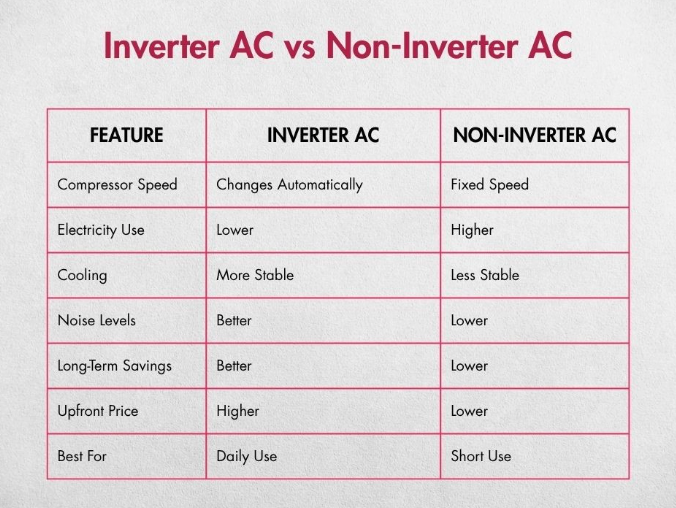
Inverter models are generally more cost-effective in the long run for families that use AC all night long during the summer.
How Much Money Does an Inverter AC Really Save in Nepal?
Electricity costs are an important concern for most families in Nepal, especially during the summer when air conditioners run for many hours every day.
The non-inverter ac consumes more power as it keeps turning off and on to keep the room at the desired temperature.
This repetition results in higher electricity usage and can cause monthly NEA bills to rise rapidly.
The inverter AC functions in another way. It varies its speed based on the necessary cooling and operates more efficiently, reducing unnecessary power consumption.
In many Nepali households, a non-inverter AC can cost between NPR 2,500 and NPR 4,000 more per month for cooling cost during the peak summer season.
Depending on your usage and room requirements, an inverter with the same capacity can reduce that cost by 30% to 50%.
These monthly savings can add up over the course of the year, particularly for families that heavily rely on AC during the summer months.
4 Specific Reasons to Choose an Inverter AC in Nepal

When selecting an AC for your residence in Nepal, it's not just about cooling. It's also about dealing with local climates, electric power problems, and usage habits.
The temperature varies in different parts of Nepal in summers with many households using ACs for extended hours.
Due to this, inverter ACs have become a viable solution for numerous families. Here are some important reasons why inverter ACs suit Nepali homes well:
1. Better for Long Summer Use
Many Terai cities such as Birgunj, Janakpur, Nepalgunj, Bhairahawa etc. experience extreme summer heat with little respite for extended periods. During the day and at night, families rely on ACs to keep them comfortable.
An inverter AC draws power more efficiently when running continuously, helping to save energy costs every month and eliminating wasted electricity during peak summer times.
2. Resists Voltage Fluctuation
Nepal still experiences voltage fluctuations on a wide scale, particularly in summer when electricity demand is high, and in unfavorable weather conditions.
Power surges or outages over time can affect appliance performance.
Inverter ACs are typically designed to handle voltage fluctuations more smoothly, resulting in more stable performance and reduced stress on critical components.
3. Compatible with Back-up Power Systems
During power outages, or at times when power supply is limited, many Nepali domestic units shift to back up inverters, generators, or domestic power systems.
Traditional ACs can be less efficient and require a significant amount of power to start, which can cause additional stress to backup systems.
One advantage of inverter ACs is that they start slower and are more likely to run with a back-up power source, which would be appropriate for some homes where electrical power is secured in other ways.
4. Consistent Cooling for Comfortable Sleep
This is because in certain areas like in Kathmandu Valley and in the hill region there is a huge gap between day and night temperature.
Traditional ACs may over-cool, and then simply stop while you're in the room, creating an unbalanced setting.
The inverter AC slowly cools it and maintains the temperature all night resulting in a wonderful sleep without experiencing any coldness during the night.
Because of these reasons, inverter ACs are becoming a preferred option for many Nepali households.
They provide increased comfort, reduced energy consumption, and improved functionality for local needs.
If you're still looking around for features, room sizes, and cooling power, then this in-depth AC Buying Guide for Nepal might be helpful in finding the right one for your home.
Choosing the Right AC Size for Your Home in Nepal
Many people focus only on inverter and non-inverter technology but forget another important factor which is the AC size.
Even the best AC can waste its electricity if the tonnage is not as per the size of the room.
If your room is very large, a small air conditioner will have a hard time cooling effectively, leaving you to constantly worry about it being on. This causes additional electricity consumption and strain on the compressor.
Over time, this can also reduce the overall life of the machine and lead to more servicing costs.
However, a larger AC can cause the room to cool too rapidly without dehumidification, resulting in undesirable moisture conditions and discomfort in rooms, particularly in monsoon months.
A 1-ton AC is suitable for small bedrooms in most of the houses in Nepal while larger living rooms may need a 1.5-ton or 2-ton according to exposure of sunlight, ceiling height, size of windows and insulation of the rooms.
If you have direct afternoon sun, your home generally requires a little more cooling power.
When purchasing an AC, always remember to measure the right size of the room and understand what cooling power is required.
Selecting the appropriate size not only enhances cooling efficiency but also reduces energy consumption and extends the lifespan of the equipment.
You can also check out this guide on important things to consider before buying an AC to make a smarter choice for your home.
EMI and Loyalty Benefits for Your AC Purchases
For many families in Nepal, purchasing an air conditioner is a significant investment, particularly during their summer months when demand is high.
Paying everything up-front can sometimes be difficult, and installment plans can ease the burden.
Better Appliances takes care of this with 0% EMI facility provided by Nabil Bank, this option will help the customer with the facility of low installments which can be paid back easily without making any big lump-sum payment.
Other advantages include added value for regular home and kitchen shoppers through the Better Loyalty Program.
Rewards points can come in handy for future purchases and daily household necessities and preferences, for eligible purchases.
Free shipping for orders more than Rs 3000 also helps to minimize the additional delivery expenses.
Better Appliances: Nepal’s Own Brand, Built for Nepali Homes
For over 25 years, Better Appliances has been supplying households in Nepal with appliances built to meet their daily needs and local requirements.
The brand has energy-efficient ACs designed for Nepal's weather patterns and power situation and also offers affordable ACs to the families.
Over 3,000 retail outlets nationwide make it convenient for customers to find sales, servicing and warranty support.
Better Appliances also supports local production with their factory located in Birgunj, creating Nepali jobs and providing reliable appliances to Nepali homes.
To ensure families enjoy better cooling and comfort during hot seasons, the company continues to be committed to quality, affordability, and dependable after-sales service. To learn more about the company and its journey, visit our about us page.
Tips to Get the Most Out of Your AC in Nepal

Taking care of an AC properly can make a big difference in both cooling performance and electricity use.
In many cases, people pay attention only to the purchase but forget that the day-today activities have a direct impact on the efficiency of the AC.
Simple maintenance and smart usage can help reduce electricity bills, improve cooling, and increase the life of the AC.
If the AC unit is running, keep doors and windows closed so that the cool air does not go out.
Clean the AC filters regularly to maintain proper airflow and better cooling performance.
Do not set excessively low temperatures as this wastes electricity for no reason.
Use curtains during the daytime to reduce heat entering the room from direct sunlight.
Have the AC serviced before summer begins so it'll run at peak performance during the busy season.
Select the right size for the room, since a big or small AC unit can waste energy.
Use ceiling fans together with the AC to circulate cool air more effectively.
Avoid unnecessary power consumption by turning off the air conditioning system when the room is left unattended for long periods.
Keep the outdoor unit clean and free from dust for better airflow and efficient operation.
Following these simple steps can help households in Nepal get better cooling while keeping electricity costs under control.
Besides the additional ease of using air conditioning in warmer periods, regular care ensures that air conditioning maintains efficiency for many years.
Inverter vs Non-Inverter AC in Nepal: Understanding the Difference for Your Home
Inverter AC has been a smart choice for most homes in Nepal, as it consumes less electricity, continues to run consistently, and helps keep electric bills from skyrocketing in summer.
While a non-inverter AC may be suitable for occasional use or lower-budget households, an inverter AC can ultimately result in cost savings for families using air conditioning frequently.
It is crucial to take into account factors like room size, weather conditions, daily use, and affordability before choosing.
When it comes to finding the right AC, opting for an energy-efficient model isn't just a matter of cooling the room. It is about managing electric bills effortlessly for years to come.
Better Appliances is the right choice when it comes to trusted home appliances, practical buying guides, and products targeted for Nepali homes.
Frequently Asked Questions
1. Which AC saves more electricity in Nepal?
Inverter ACs usually use less electricity because they adjust the compressor's speed rather than constantly turning on and off.
2. Is an inverter AC worth the higher price?
Yes, for homes that use the AC regularly. This may help offset the extra up-front costs over time, as electricity use is reduced.
3. How much can an inverter AC save monthly?
Many households can save NPR 1000 - NPR 2000 per month on their electricity bill during the summer when there is heavy usage.


Comments