

Fridge Monthly Electricity Cost in Nepal by Size (50L to 195L)


Whereas an AC or a heater can be switched on or off, your fridge is never really off.
The refrigerator on your electricity bill in Nepal is one such cost that silently operates 24/7 in your kitchen throughout the year.
Again, not many people take the time to work out the cost of their fridge per month, simply assuming it's small and nothing more.
Let’s run the numbers, size by size, so you know exactly what you are paying to keep your food cold.
How to Estimate Fridge Electricity Consumption in Nepal?
A refrigerator doesn't operate its compressor all the time. It brings the interior temperature down to the desired temperature, turns off, and then turns back on when the temperature rises again.
These on-and-off cycles are known as the duty cycle, which is the main factor for accurately estimating the electricity consumption of fridges in Nepal.
In a typical family kitchen, a small direct-cool fridge runs its compressor 30 to 40 percent of the time, so the wattage you see inside the door isn't what it consumes 24/7. It just shows what it consumes when it is working.
The simple formula looks like this: average watts multiplied by 24 hours, divided by 1000, gives you the daily units consumed, and multiplying that by 30 gives you a monthly figure.
Typical Wattage and Consumption by Fridge Size
Fridges with a small, single door and direct cooling, such as those popular among Nepali households, use significantly less electricity than large double-door and side-by-side fridges popular in larger kitchens in other countries.
According to detailed refrigerator wattage and cost breakdowns for South Asian single-door models, compressor running power for single-door fridges typically falls between 60 and 100 watts, with smaller capacities sitting toward the lower end of that range.
Applying that pattern across the Better Arctic refrigerator sizes, here is roughly what each model draws and consumes in a typical Kathmandu kitchen.
50 liters: around 60 watts of running power, roughly 13 units consumed per month
100 liters: around 65 watts of running power, roughly 15 units consumed per month
170 liters: around 75 watts of running power, roughly 19 units consumed per month
195 liters: around 80 watts of running power, roughly 21 units consumed per month
These are only estimates for a fridge in a normally ventilated kitchen at normal room temperatures.
The actual electricity consumption of a fridge in Nepal may vary slightly depending on how often the fridge door is opened, the contents of the fridge, and the kitchen temperature during summer.
NEA Tariff Rates Applied: What Each Size Actually Costs You Per Month

Let's now convert those units to real rupees based on the consumer tariff rates published by NEA.
The fridge units usually fall in the middle tariff band of NPR 9.50 per unit, as most of the households have other appliances in the house and the lights on, along with the water pump.
Using that rate as a realistic working figure for most homes, fridge electricity consumption in Nepal translates to real monthly costs that are genuinely modest, even for the largest model in the range.
Fridge Electricity Consumption in Nepal: Monthly and Yearly Cost Table
The complete picture, from smallest to largest, at the NPR 9.50 per unit rate (where most households are), with other appliances accounted for.
50-liter fridge: NPR 123 per month or approximately NPR 1,500 per year.
100-liter fridge: costs around NPR 142 per month or nearly NPR 1,730 per year.
170-liter fridge: costs about NPR 180 per month or NPR 2,185 annually.
195-liter fridge: costs around NPR 203 per month or NPR 2,463 per year
If your overall consumption remains low enough to fall in NEA's cheapest slabs, these numbers will be much lower.
If your monthly consumption consistently moves to the top slab of the NPR 11 range, it will be slightly higher, but even at the highest level, a 195-liter fridge costs only about NPR 234 per month.
Compared to appliances like an AC or a water heater, fridge electricity consumption in Nepal is genuinely one of the smaller line items on your bill.
Why Does a Fridge Cost Less Than You Think Compared to an AC or Heater?
It helps to see this next to a heavier appliance for perspective.
In summer, a 1.5 Ton AC used for a few hours per day adds a few thousand rupees to the bills, and even a large 195-liter fridge, used 24/7, adds a couple of hundred rupees per month.
The difference comes down to wattage: a fridge's compressor is a small, efficient motor built to run in short bursts, while an AC compressor is a much larger unit built to move a lot more air.
If you have been holding off on replacing an old fridge because you were concerned about the price, this is good news in Nepal. Fridge electricity consumption is rarely the appliance responsible for a shockingly high electricity bill.
Tips to Lower Your Fridge's Electricity Use Further
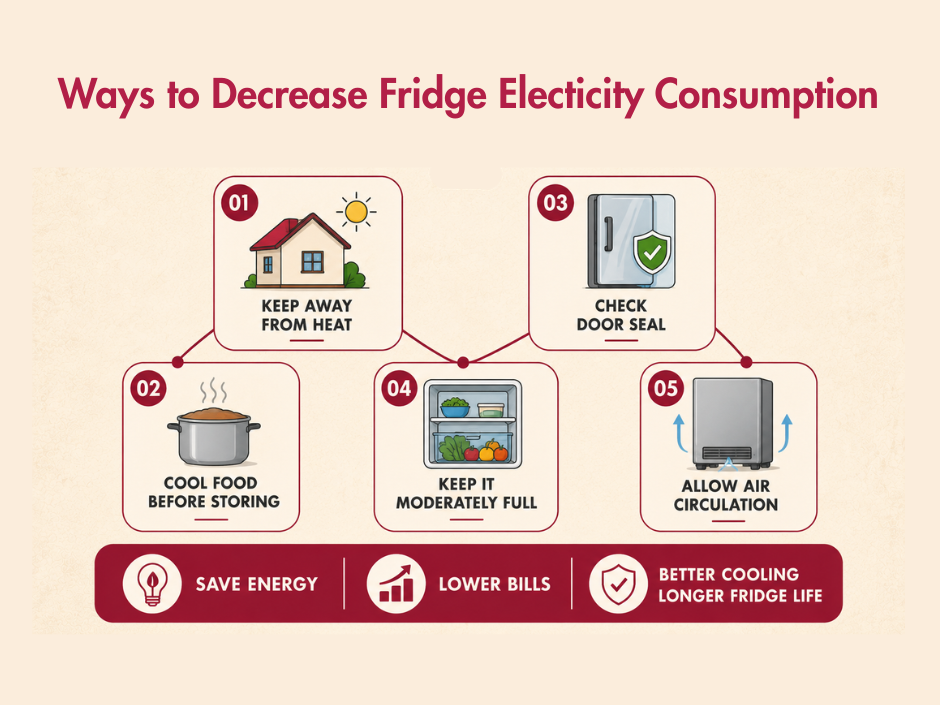
These numbers can be reduced a bit with small habits that don't require much effort.
Don't place the fridge next to a stove or in direct sunlight, as this means the compressor will have to work longer to maintain the set temperature.
Do not place hot food into the unit, as the compressor will work overtime to cool it down.
Inspect the door seal often. A worn gasket allows cold air to seep in gradually throughout the day without you realizing it, raising the duty cycle.
Keeping the fridge reasonably full, without overpacking it, also helps maintain a steadier internal temperature with less compressor cycling.
Choosing the Right Fridge for Your Budget and Household
The difference in electricity expenses among sizes can be very negligible, so the choice depends on the space your home needs, rather than which size is the cheapest to operate.
1) Better Arctic 50L Refrigerator
The Better Arctic 50 Liter Refrigerator is ideal for one person or a rented small room.
It is a small, efficient fridge suited to limited space, offering 50 liters of capacity and ideal for storing essentials.
2) Better Arctic 100L Refrigerator
If you're looking for a fridge that is best for couples or small families, then the Better Arctic 100 Liter Refrigerator is a top choice.
It has a large voltage range and does not require a stabilizer. Quick freezing preserves your food and makes it last longer.
3) Better Arctic 170L Refrigerator
If your family needs additional space for vegetables, dairy, leftovers, and weekly grocery shopping, the Better Arctic 170 Liter Refrigerator is a popular choice among larger families.
Its 170-liter capacity is sufficient for a small to medium family for their daily use.
4) Better Arctic 195L Refrigerator
Those who require maximum storage space may consider the Better Arctic 195-liter.
It has a 195-liter capacity, which makes it fit medium- to large-sized families.
If you want a deeper breakdown of size, features, and which household they fit, our guide on choosing the best fridge walks through that decision in detail.
Every Better Arctic fridge is CFC-free, designed to operate on a broad voltage range without requiring a separate stabilizer, and comes with a 7-year compressor warranty and a 2-year comprehensive warranty.
All the models include home servicing across the country, so if anything needs fixing years later, help will be available.
The EMI Service with Nabil Bank will allow you to spread larger payments, such as refrigerators, over regular monthly installments, and each order ships for free.
Regular customers can also build up points with the Better Loyalty Program.
If you're looking to upgrade your kitchen or find other reliable appliances, you can explore the entire kitchen and home collection on the Better Appliances homepage.
You can contact the team if you need help matching a fridge or any other appliances to your household.
Running Cost of Fridge in Nepal
Fridge electricity consumption in Nepal is one of the more reassuring numbers on your monthly bill.
Even the largest 195-liter model costs only a couple hundred rupees a month to run, all day, every day.
When selecting a fridge, it should come down to space requirements, not the small savings on electricity usage made across the whole range.
Explore the top fridges in Nepal and find the size that fits your kitchen and your family.
Frequently Asked Questions
1) What is the average fridge electricity consumption in Nepal per month?
For a typical single-door fridge between 50 and 195 liters, monthly consumption ranges from roughly 13 to 21 units, costing somewhere between NPR 120 and NPR 205 for most households.
2) Does a bigger fridge always cost significantly more to run?
Not by much. The difference between a 50L and a 195L fridge is only NPR 80 per month in a fridge bill, which is negligible compared to the storage space they offer.
3) Is a fridge more expensive to run than an AC in Nepal?
No. A fridge runs continuously but draws very little power at a time, while an AC draws far more power over fewer hours, making the AC the far bigger expense during the summer months.
4) Does keeping the fridge fuller reduce electricity use?
Yes, to a point. A fairly full fridge maintains the temperature more easily than an empty fridge, but when too full, this disrupts the flow of air and can cause the compressor to overwork.
5) Do Better Arctic fridges need a voltage stabilizer in Nepal?
Not necessarily. All the models support a wide voltage range and don't require a separate stabilizer.
6) How can I check my own fridge's real electricity cost?
Note your NEA meter reading, run the fridge normally for a week, check the reading again, and multiply the difference in units by your household's current tariff rate for an accurate personal estimate.


Comments